
What protects a sofa, a box of contracts or a van load of stock after it's been sitting in storage for two years? For long term storage in Nottingham, people compare price and square footage first. That's the wrong order. The better question is whether the unit, the site and the written agreement will still be working for you in month eighteen, when condensation, access limits or an unclear insurance exclusion matter more than the introductory offer did on day one.
What Long Term Storage Means and When It Makes Sense
A long term storage facility is a secure, lockable space rented for months or years to hold possessions, stock or records that don't need daily access. A short term locker is like a hotel room you leave tonight. Long term storage is closer to a second home, where the building, the lock and the upkeep matter more than the monthly bill.
Typical triggers include a gap between selling and moving in, renovation work that leaves rooms unusable, an extended stay abroad, students storing belongings between terms, and businesses holding surplus stock or archives that have outgrown the office. It's a mature sector, and the Self Storage Association UK figure reported in the UK Annual Industry Report 2024 puts UK self-storage turnover at £1.08 billion in 2024.
Items sitting untouched for more than a few weeks should be judged on protection and written terms, not price alone.
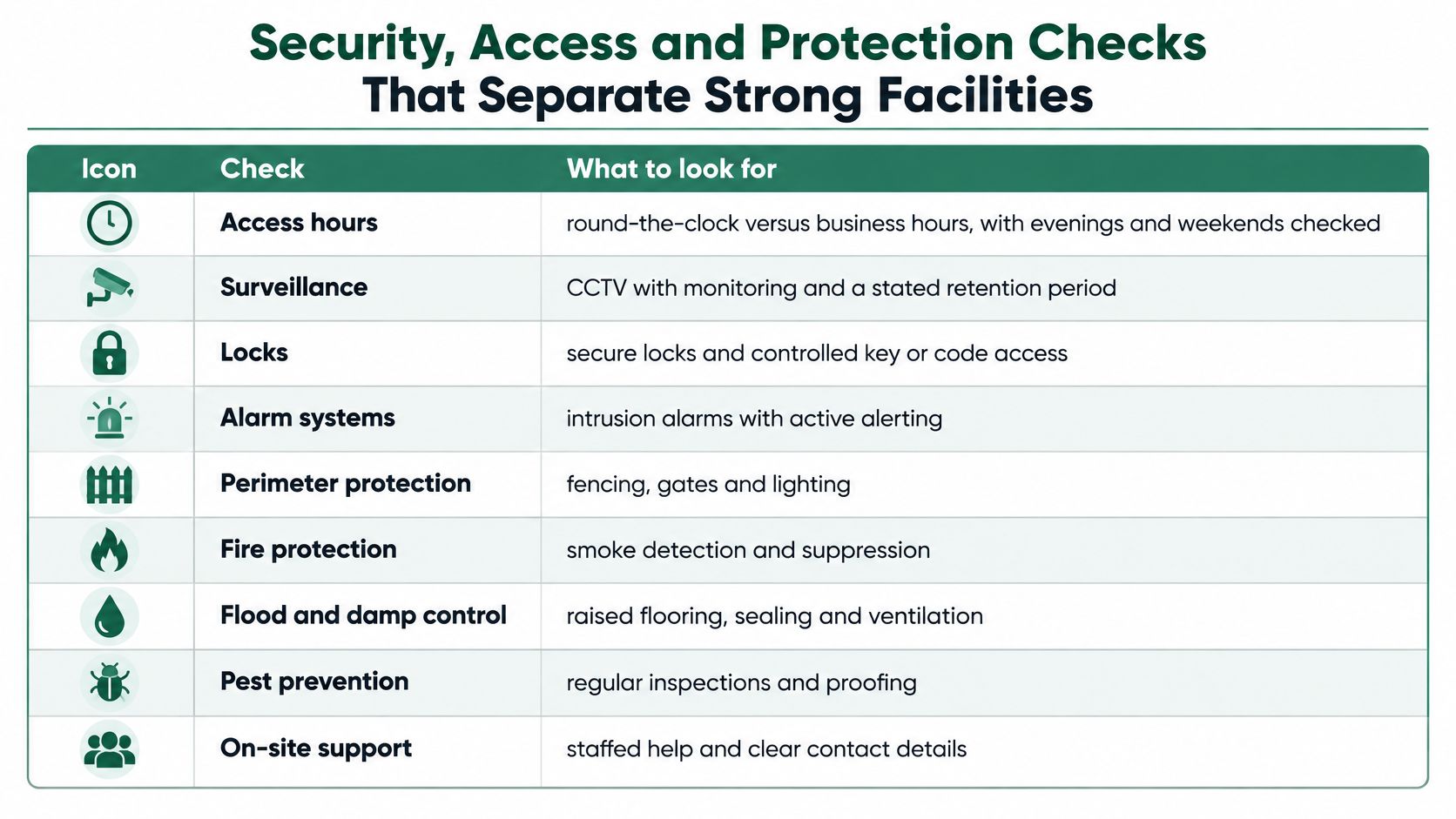
Security, Access and Protection Checks That Separate Strong Facilities
Use this table against every secure long term storage option before booking. A facility failing three or more rows is a weak candidate, whatever its price.
| Criterion | What good looks like | Why it matters | Red flag |
|---|---|---|---|
| Access hours | Stated hours cover evenings and weekends | Limited hours slow retrieval | Vague or undisclosed hours |
| Surveillance | CCTV with monitoring and a stated retention period | Deters theft and supports claims | No recording or no stated policy |
| Perimeter and lighting | Secure gates and floodlighting | Limits unauthorised access | Open boundary or poorly lit site |
| Unit type | Drive-up container, internal unit or yard space | Determines loading and weather exposure | Unit type mismatched to your contents |
| Ground-level access | Vehicle parks directly at the door | Less lifting and fewer damage risks | Stairs or lifts for heavy items |
| Environment | Ventilation, anti-condensation lining and raised flooring | Limits damp and mould over time | Sealed or unventilated units |
| Locks and keys | Customer-owned padlock with a clear key policy | Controls who can enter | Shared or unclear key arrangements |
| Insurance | Facility cover or your own contents policy confirmed in writing | Covers losses the site does not | Assumed cover with no written terms |
| Staffing and notice | On-site staff and a stated notice period | Eases problems and planned exits | No contact details or unclear exit terms |
Security and access basics
There's no single UK access model. The Self Storage Association UK customer FAQ states that some facilities offer 24/7 access, while others operate only during normal business hours or restrict evenings and weekends. The same guidance says members must have CCTV monitoring, a secure perimeter, and compliance with fire and safety regulations, while customers normally secure their own units with a padlock, retain the keys and remain responsible for insuring stored goods.
Ask how long footage is kept. At Saxondale Self Storage, CCTV recordings are kept only as long as needed for security and are then overwritten, and insurance for stored goods is covered in the storage agreement rather than on a marketing page.
Damp, condensation and flood risk
Temperature swings create condensation on cold surfaces inside enclosed units. Keep goods off concrete, away from walls and raised on pallets, because the floor and wall line are where moisture damage usually starts. Ventilation matters too, since stagnant air lets humid pockets form around textiles and boxed paper.
For records, the National Archives environmental management guidance identifies approximately 13 to 20°C and 35 to 60% relative humidity as suitable broad conditions for paper, with stability stressed throughout. It also warns that humidity below about 40% can make paper dry and brittle. A standard unconditioned unit isn't an archive, so sensitive records need calibrated data loggers or specialist storage.
Check the Environment Agency flood maps for the site postcode and ask about drainage and raised thresholds. The Cushman and Wakefield UK Self Storage Annual Report page is a useful starting point for sector context, but the site specific check is what protects your goods.
Insurance exclusions
Facility cover can exclude flood, escape of water, vermin, unattended property and poor packing. Read the exclusions, confirm cover in writing, and photograph everything before the first night. Assumed cover is no cover.
Rental Terms and the True Cost of Long Term Storage
A unit advertised at £110 a month is a £1,320 commitment over a year, before insurance, any deposit and the journeys to and from it. Comparing headline rents alone misses most of the actual spend. Work out monthly fee multiplied by months, plus deposit, insurance and retrieval journeys before comparing quotes for storage units for long term use.
| Term or charge | What it usually means | Question to ask | How it changes the total |
|---|---|---|---|
| Rolling monthly rental | Open-ended, paid month to month | What is the minimum term and notice period? | Flexible, but no long-term discount |
| Fixed-term commitment | Set number of months | Are there early-exit charges? | Locked in if plans change |
| Annual upfront payment | Pay for twelve months in advance | What are the refund rules if you leave early? | Lower monthly cost only if you stay the full term |
| First-month discount | Introductory offer on a new rental | Does it apply to monthly bookings? | One-off saving only |
| Refundable deposit | Held against the lock or unit condition | What are the return conditions and timing? | Deductions possible for damage or missing items |
| Insurance | Facility cover or your own contents policy | What is excluded, in writing? | Cost of cover, or risk if none is confirmed |
| Access or admin charges | Fees beyond standard use | Do any apply to my rental? | Adds to the total if they apply |
| Transport for retrieval | Van or fuel costs for each visit | How often will I need access? | Frequent visits can outweigh a low monthly fee |
Every row in that table lands in one document: the storage agreement.
Typical agreements limit unit access to the customer or agents named on the account. Most allow the facility to refuse entry while charges are outstanding or where safety and security are at risk. Staff entry for inspection or repairs normally requires notice, though emergency access is permitted without it to prevent injury or property damage. Terms differ between operators, so confirm each point in the agreement you sign.
For businesses renting stock space, name authorised staff in the agreement, keep a photographed inventory and retain VAT invoices. Analysts at Savills report business-related storage use rising from 8.7% in 2014 to 16.2% in 2025 in their UK and European self storage roundup, which means access frequency and stock rotation belong in the rental decision from day one.
Saxondale Self Storage offers a concrete comparison point: units start from £110 a month including VAT, the first month is offered at half price, and a one month minimum may apply before cancellation follows the storage agreement. Weigh that kind of flexible entry against any fixed-term quote, because a discounted headline rate loses its value the moment plans change and an early-exit charge applies.
Choosing the Right Unit Size for Your Belongings
Start by listing the largest items, measuring them, and adding clearance so front boxes can be reached without moving everything. The guide to storage unit sizes and prices helps translate that list into floor area before anything is booked.
| Floor area | Typical contents | Suits | Planning note |
|---|---|---|---|
| 25 sq ft (about 5 x 5 ft) | Boxes and small seasonal items | Student belongings between terms | Keep a clear route to the door |
| 50 sq ft (about 5 x 10 ft) | A mattress, a few boxes and a small wardrobe | A single room or small studio | Stack boxes on pallets to save space |
| 100 sq ft (about 10 x 10 ft) | A sofa, dining set and boxed contents | A one-bedroom flat | Measure the largest pieces before deciding |
| 150 sq ft (about 10 x 15 ft) | Most contents of a two-bedroom home | A two-bedroom household | Leave walkways for retrieval |
| 200 sq ft (about 10 x 20 ft) | Larger household contents or trade equipment | A three-bedroom home or workshop stock | Confirm vehicle access and turning space |
A single room of furniture usually needs more space than expected once walkways are included. For business stock, keep weekly lines nearest the door and push seasonal or archived items deeper. Check the actual usable floor area and access route with the facility, since advertised sizes can differ from the space you can load.
How to Prepare Furniture and Possessions for Extended Storage
Good preparation matters as much as the unit for long term furniture storage in Nottingham. The overview of furniture storage options covers the container itself, but the packing decisions below are what keep contents sound over years.
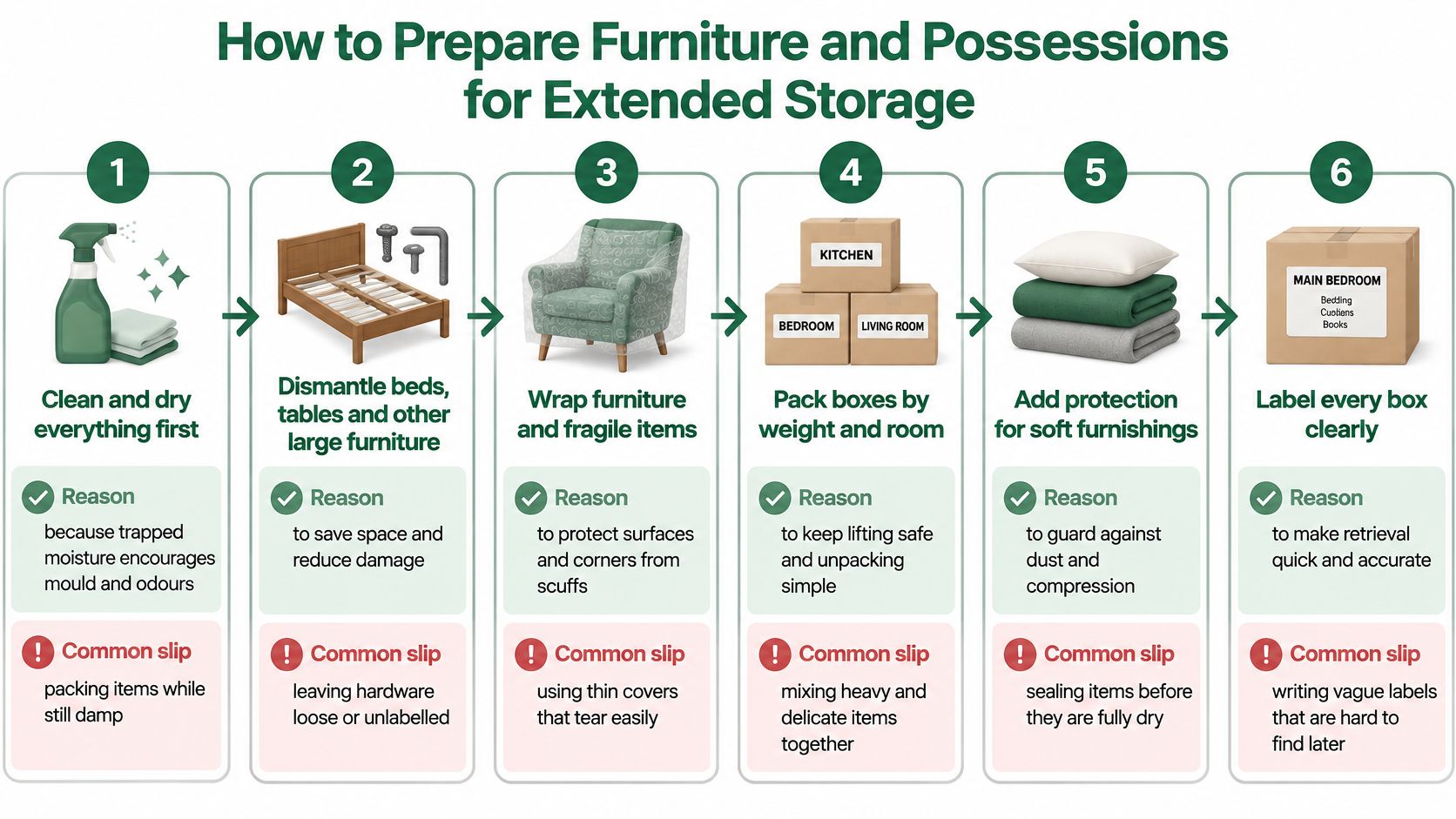
- Clean and dry everything first. Trapped moisture encourages mould and odours. The common slip is packing items while they're still damp.
- Dismantle beds, tables and wardrobes. Bag the fixings and tape each bag to the part it belongs to. Loose, unlabelled hardware gets lost.
- Wrap upholstery and wood in breathable covers. Cotton or non-woven fabric works. Airtight plastic on fabric traps humidity against the surface.
- Protect mirrors, glass and framed pictures. Use cardboard corners and padding, and store them upright rather than flat under weight.
- Lift everything off the floor. Pallets or bases keep contents clear of cold flooring and any minor water ingress.
- Box, label and inventory. Label by room and contents, keep a written list, and photograph high-value items for insurance.
- Load heavy furniture first, at the back. Fragile boxes go last, near the front, with a walkway left to the door.
- Add moisture absorbers. Place them where air circulates and replace them as directed on the packaging.
- Check after the first month and each season. Early checks catch condensation, pests or a failing cover before damage spreads.
Non-negotiable rule: never store anything illegal, dangerous, flammable, perishable or living, or anything that could damage the property or other customers' goods.
Shortlist a Nottingham Facility and Book Your Unit
Saxondale Self Storage operates two sites east of the city, at St James Business Park in Radcliffe on Trent and Upper Saxondale Business Park. Both accept cars, vans and small trailers but not HGVs. Ground-level access helps with heavy furniture, though drive-up units still need the damp and security checks set out in the criteria table. The page for self storage in Nottingham sets out the local options for long term self storage in Nottingham.
Furniture and household storage sits in a dry, ventilated, wooden-floored container with room for full furniture sets, with units starting from £110 a month including VAT.
- Send an online enquiry. A request on the website isn't a confirmed booking.
- Confirm availability and price in writing, since prices can change.
- Complete the storage agreement and check the notice period, access rules, emergency entry terms and insurance. A unit is only reserved once availability and price have been confirmed and the agreement completed.
- View the unit where possible before the first delivery.
Find a Suitable Long-Term Storage Unit once those four steps are done.
Frequently Asked Questions About Long Term Storage
How long can items stay in storage?
Check the storage agreement for the minimum rental period, how to give notice and the steps for ending the rental. Saxondale Self Storage may require a one-month minimum, after which customers can cancel as set out in the agreement.
What happens if a payment is missed?
The storage agreement sets out payment requirements and the consequences of missed payments. Read those terms before renting, and contact the storage team promptly if you think you may have difficulty paying on time.
Is separate insurance needed?
Insurance for stored goods is covered in the storage agreement. Check what cover applies and whether you need to arrange your own contents insurance.
Can the unit be accessed at weekends?
Yes. Access is available from 7am to 7pm every day, as shown in the access details above.
Who holds the key to the unit?
Each unit has an individual padlock. Check the agreement for the access arrangements and keep your keys secure.
What can't be stored?
Household, business and similar goods are suitable, but illegal, dangerous, flammable, perishable or living items are prohibited. Motor vehicles, quad bikes, motorbikes and anything that could leak fluid are also not permitted.
Can a business store stock and records?
Yes. Businesses can use units for stock, tools, equipment and records on the same flexible terms as other customers. Check the agreement for the rules that apply to your goods and rental.