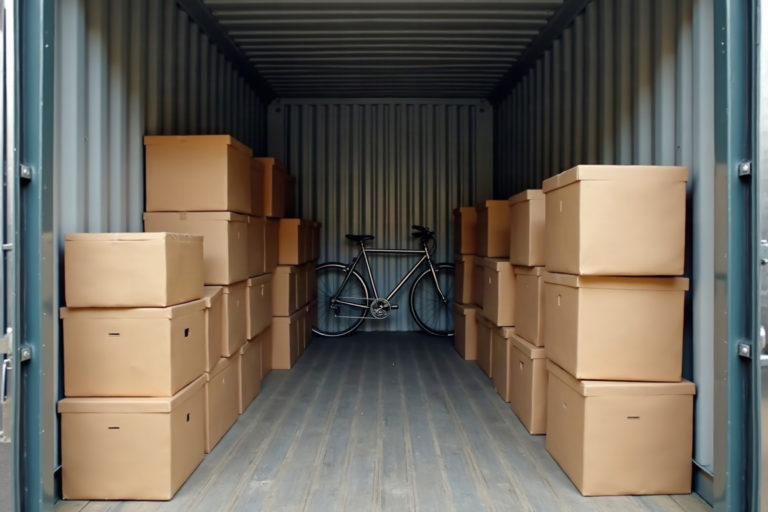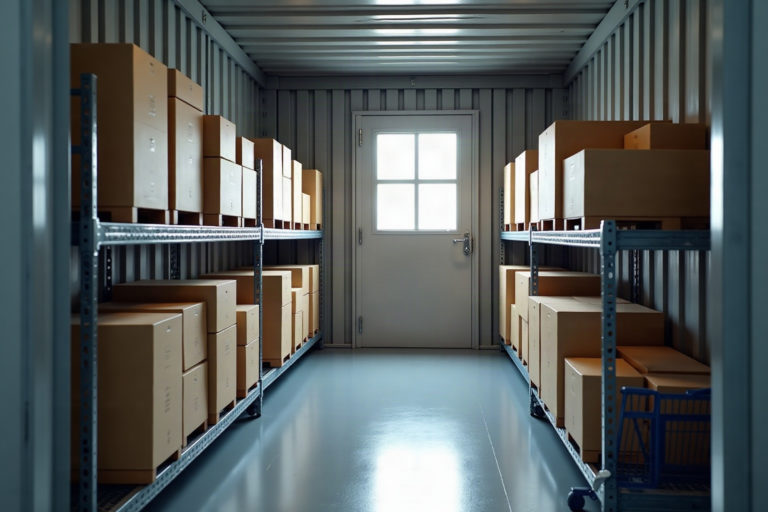
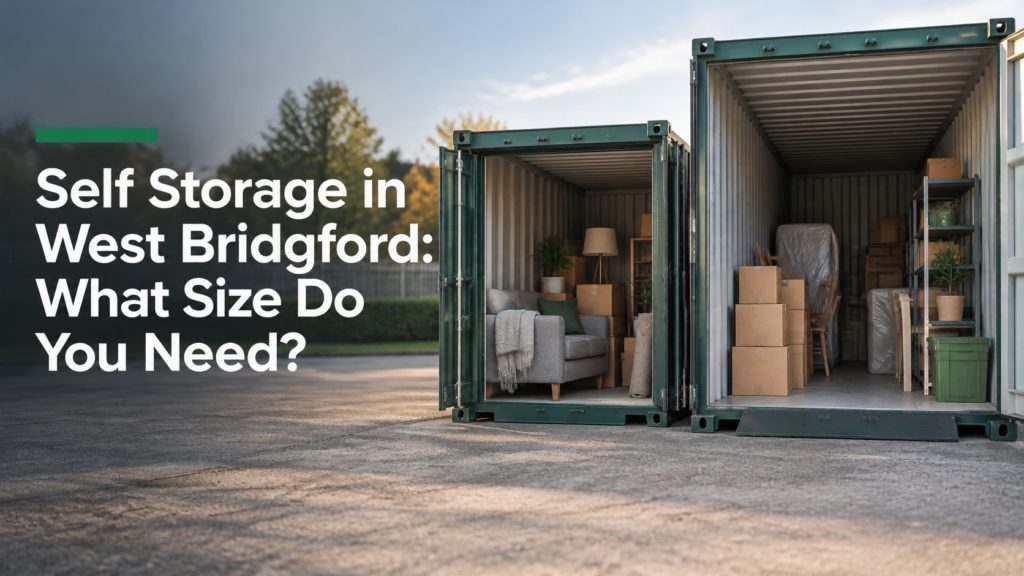
A 10ft container gives about 80 sq ft and suits one room, a one-bedroom flat, or a compact load of tools and boxed stock. A 20ft container gives about 160 sq ft and suits a full house move or a retailer's seasonal stock.
The van is on the drive, the sofa won't turn in the hallway, and the new keys aren't ready until Friday. Self storage in West Bridgford only works if the unit still has an aisle once that sofa is inside. Paper volume isn't the same as a load you can unload.
Which Unit Size Fits Your Belongings
For most household and stock needs around West Bridgford, a 10ft unit (about 80 sq ft) covers one room or a small flat, and a 20ft unit (about 160 sq ft) covers a full house or a heavier stock load. Saxondale Self Storage offers only these two container sizes, so the decision is which of those two matches the load.
| Belongings or use | Likely unit | Why it fits |
|---|---|---|
| Boxes and small items from one room | 10ft (about 80 sq ft) | Fits one room's boxed goods with an aisle to reach them |
| Sofa, mattress and a few chairs | 10ft (about 80 sq ft) | Fits when mattresses stand on edge and the sofa stays clear of the door |
| One-bedroom flat contents | 10ft (about 80 sq ft) | Usually fits, but check bed frames and wardrobes |
| Two-bedroom home contents | 10ft or 20ft | Use the 20ft when several bulky pieces travel in one load |
| Three-bedroom house contents | 20ft (about 160 sq ft) | Matches three-bedroom guidance; confirm the bulky items |
| Trade tools, materials and van stock | 10ft (about 80 sq ft) | Tool sets and materials fit on shelves and in tubs |
| Retailer's seasonal or surplus stock | 20ft (about 160 sq ft) | Pallets and cartons need floor space to rotate |
| Office files and archive boxes | 10ft (about 80 sq ft) | Boxes stack to a safe height in labelled rows |
Sofas, bed frames and wardrobes decide the row more than box counts do. Furniture storage is the usual reason a one-bedroom load tips from a tidy 10ft into a cramped one.
If the list sits between two rows, take the larger unit when pieces are bulky or stock is likely to grow. A unit that's too small costs extra trips and a second move. Every figure in the table is a planning estimate. Measure the actual pieces before you book.
How Unit Sizes and Dimensions Are Measured
Container sizes are quoted by external length. A 10ft unit is about 3.05 m long and a 20ft unit is about 6.1 m. Both are commonly around 8ft (2.44 m) wide. That gives floor areas of about 80 sq ft (7.4 sq m) and 160 sq ft (14.9 sq m).
Floor area is the table you have to clear. Height is how far you can stack before the top layer is out of reach.
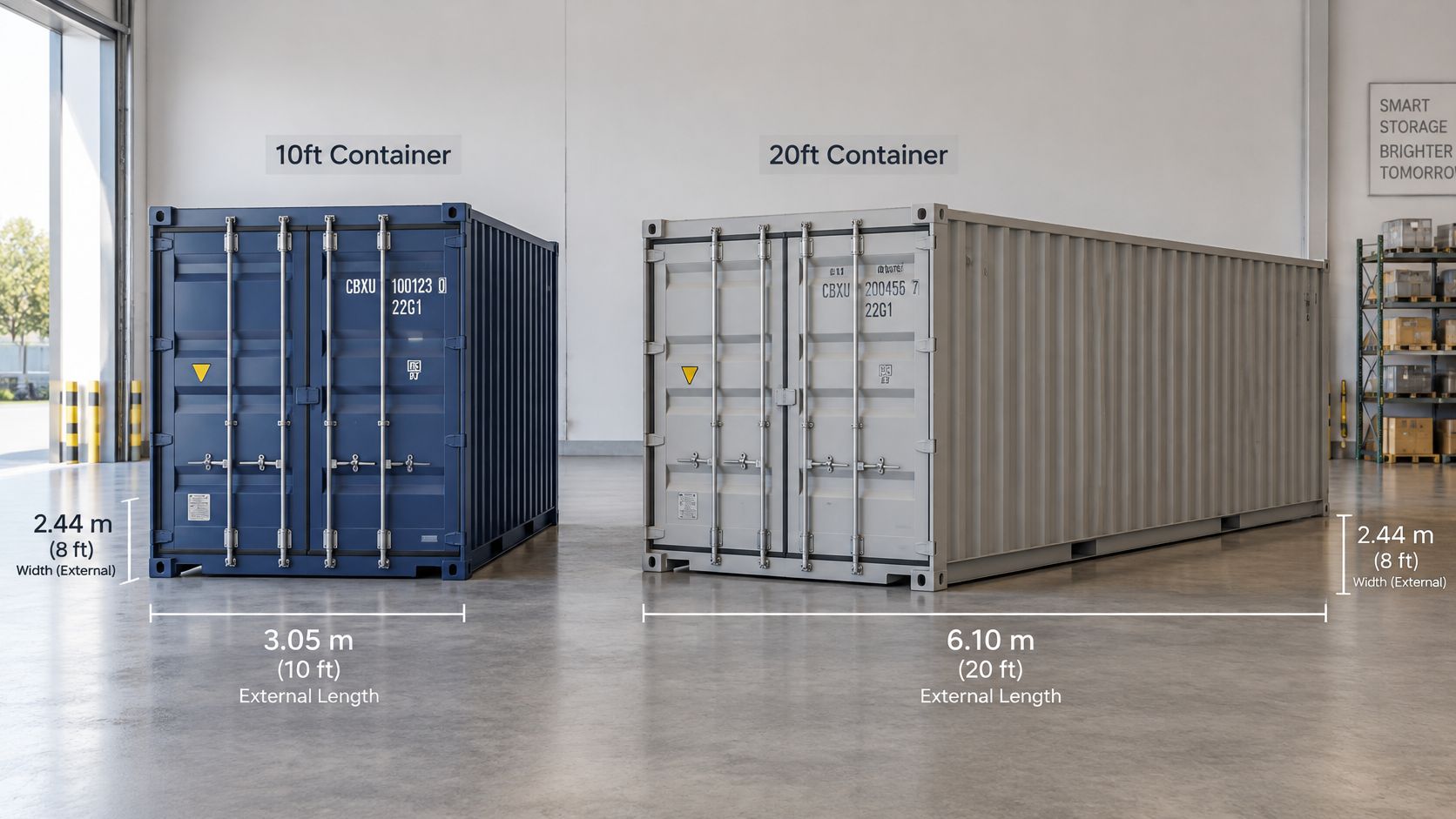
Those labels leave three gaps.
Nominal length: The printed size is the external shell. Internal length and width can sit a little inside the label.
The doorway: The opening is narrower than the floor, so a wardrobe that fits on the plan can still jam at the threshold.
Fillable space: An aisle, a standing mattress and a gap around furniture all eat the square metres you thought you had.
| Unit | Internal height |
|---|---|
| 10ft | Confirm on viewing |
| 20ft | Confirm on viewing |
Ceiling height is the figure often skipped. Ask for the internal measurements at a viewing and set them against your longest and tallest item before you assume a wardrobe stands up.
How to Work Out Your Space Needs
Size the unit from footprints, not from a room count.
- List every item. Mark the bulky ones separately, because a sofa, bed, wardrobe, fridge or desk sets the unit, not the boxes.
- Measure length and width of each bulky piece and add those footprints.
- Count boxes by room. Estimate the floor they take, stacked only to a height you can reach safely.
- Add an aisle of roughly one box width along each side so the back row stays reachable.
- Add about 20 per cent for retrieval and for items you haven't listed yet.
- Compare the total with the floor areas. At 7.4 sq m (80 sq ft) or under, a 10ft unit is usually enough. Above that, plan a 20ft unit (about 14.9 sq m).
- Set the loading order so items you need first sit by the door.
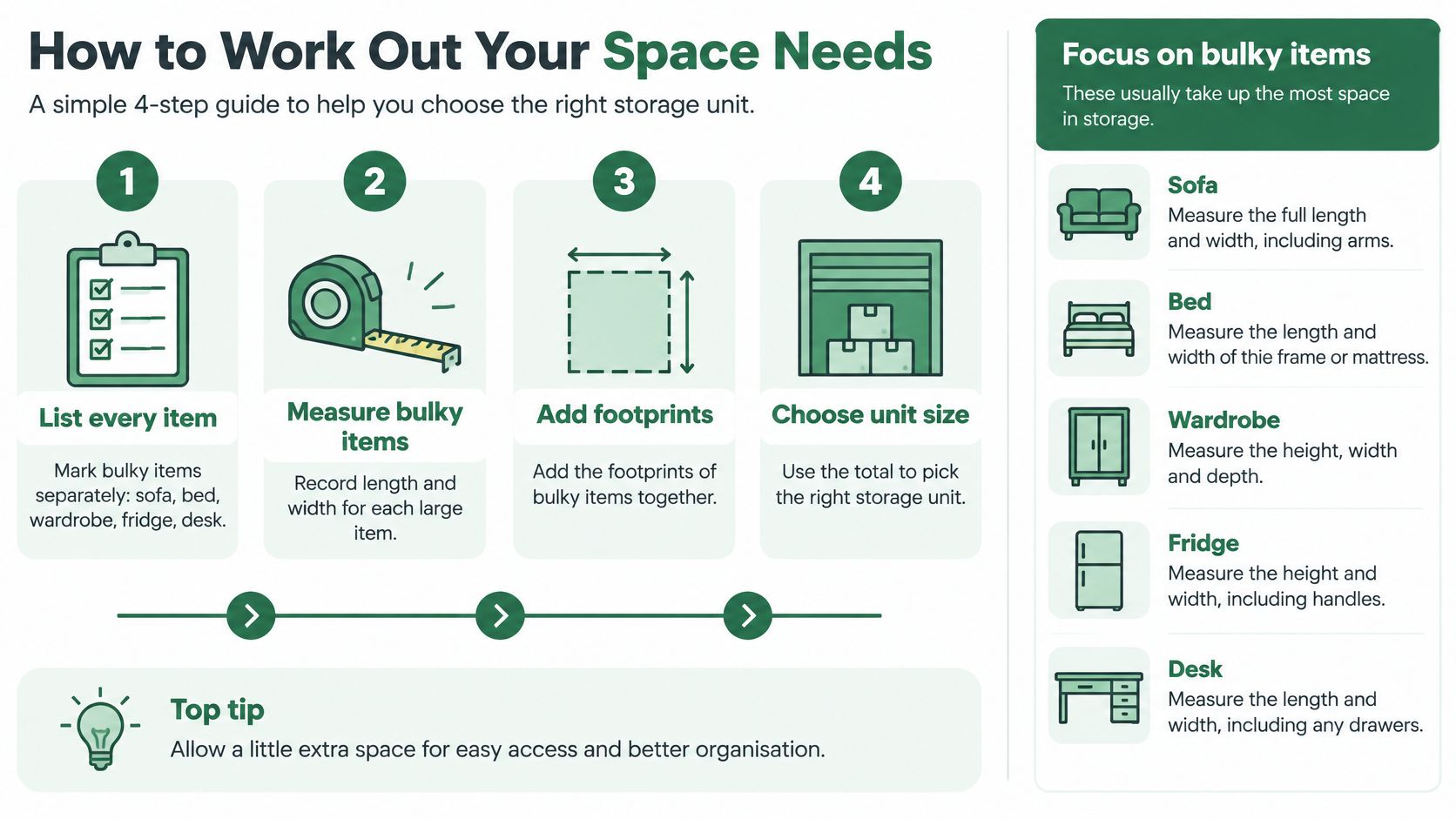
Say a sofa is 1.8 sq m, a double bed is 2.8 sq m, and 20 boxes at about 0.2 sq m each add 4.0 sq m. That's 8.6 sq m before aisles. With the 20 per cent margin the total is about 10.3 sq m, so the 20ft unit is the safer choice. A useful plan is a written list with the total floor figure, the stacking heights and a confirmed unit size.
Household Moves, Students and Renovations
Family moves, renovations and downsizing create short spells of furniture storage even when nobody wants a permanent unit. The right unit depends on more than total volume: what has to fit through the door on move day, how high you can safely stack, and the order items come off the van all shape the choice.
On a house move, boxes and non-essential items go in first and furniture follows once the new home is ready. Drive-up loading from a car, van or small trailer skips stairs and lifts, which matters far more with a sofa on a hot day than with cartons. Load the pieces you will need soonest nearest the door, and keep one box width of aisle along a side so the back row stays reachable.
For a renovation, furniture leaves the rooms while floors are sanded or walls are plastered. Wrap sofas and wardrobes in sheeting before they go in, seal every box, and size the unit for the rooms being worked on rather than the whole house. Ventilation and a timber floor keep goods off the metal base and limit condensation. Skip damp items entirely, and leave air around furniture so it can breathe. Work tends to overrun, so treat the quoted timescale as a minimum when you plan the storage term.
Students usually only need what will not fit in a bedroom over summer. Student storage units can be shared between housemates or friends, which splits the cost. Agree the loading order between you, because whoever stores first ends up at the back.
Practical rule: Sort the keep list before you book a downsize. A smaller home means fewer pieces, so measure what you're keeping, not what you're leaving.
A three-bedroom house emptied in two stages, with the sofa set and bedroom furniture going in together, points to a 20ft unit. If those bulky pieces can be split across two visits, a 10ft unit may cover each stage.
Bulky Furniture, Stock and Business Records
Take beds apart where you can, stand mattresses on edge, and remove sofa legs. Empty and dry appliances before they go in. Keep heavy pieces off stacked boxes and leave an aisle beside the largest item.
For stock, count pallets rather than cartons. A standard UK pallet is about 1.2 m by 1.0 m, so each one needs a clear path to its row. Tools sit better on wall racks or in labelled tubs, which frees the floor for goods you rotate. Business storage in Nottingham on the same rolling terms suits surplus stock and trade kit without a second warehouse.
Records are sized by time as well as volume. HMRC's retention schedule lists one year for many production, stock and job records, three years for import, export and warehouse-delivery documents, four years for purchase invoices, sales invoices and several retail records, five years for bank statements, paying-in books and management accounts, and six years for records containing the VAT account. Where one document falls into more than one category, the longer period applies.
A retailer keeping four years of sales invoices and five years of bank statements should label boxes by year. The oldest invoice boxes can then be reviewed without disturbing the bank records.
Common Sizing Mistakes and What Can Go Wrong
The usual error is counting boxes and forgetting the sofa and wardrobe. Measure those pieces first, or the aisle disappears on move day.
Packing to the ceiling is the next trap: a full-height front row hides everything behind it, so a unit that fits on volume still fails once you need a box at the back. Renting for the peak load wastes money the other way. If a staged plan would clear the bulky pieces in two visits, you pay for floor you never use.
Self storage is for household, business and similar goods. Anything illegal, dangerous, flammable, perishable or living is banned, along with anything that could damage the property or other customers' goods. Check the agreement before garden chemicals or food stock go on the van.
Water is the risk a booking can't rule out. Nottinghamshire's strategic flood risk assessment records flooding in West Bridgford across four separate years, from main rivers, ordinary watercourses and surface runoff. It names the River Trent as the county's dominant catchment, with official flood-warning areas extending along the Trent through West Bridgford. Heavy rain and drainage overload can flood a street well away from the river, so ask about the site's history rather than judging by distance from the Trent.
Ground-level units take the water first. Check flood warnings for the site before you load, and ask how the access road copes in heavy rain.
Frequently Asked Questions About Storage Sizes
Is a 10ft unit big enough for a one-bedroom flat?
Often, if bed frames and wardrobes can be dismantled or stood on edge. Measure those pieces, add an aisle, and only then decide. A solid wardrobe left in one piece is what usually pushes the load over.
What is the floor area of a 10ft unit?
About 80 sq ft (7.4 sq m): a 10ft container runs roughly 3.05 m long by 2.44 m wide. Treat that as the loading footprint, since door position and how deep you stack decide how much of it stays usable.
Can one unit handle a move done in two stages?
Yes, and it often works better than sizing for the peak. Stack what leaves first nearest the door, keep a pull path clear to it, and the second trip takes the front row without disturbing the back of the unit.
Can you store business records in a self-storage unit?
Yes, if the records stay within the storage terms. Retention periods depend on record type, so label archive boxes by type and date. That labelling is what makes a later review possible without unpacking the whole unit.
What if the load sits between the two sizes?
Get in touch before booking the larger unit. Saxondale Self Storage offers two container sizes only, so describe the bulky pieces and ask whether the smaller one works with tighter stacking before committing.
Choose a Site and Confirm Your Unit Size
Saxondale Self Storage has two sites east of Nottingham: St James Business Park in Radcliffe on Trent and Upper Saxondale Business Park. Compare both against your own route from West Bridgford on a map. This guide doesn't quote travel times.
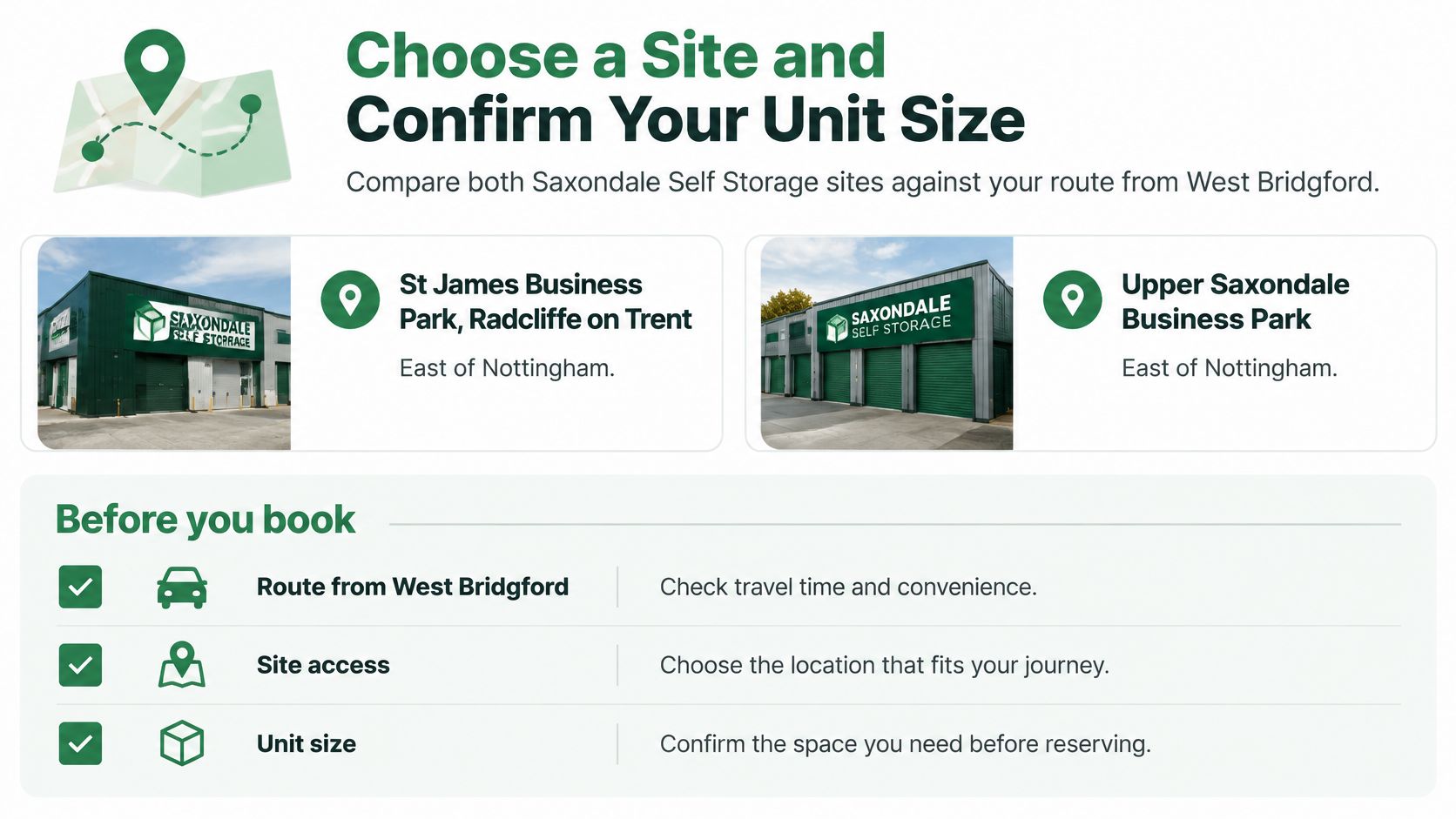
Before you book, confirm five points.
- Floor figure: Match your total to the 10ft (about 80 sq ft) or 20ft (about 160 sq ft) unit.
- Shell: Check internal measurements and ceiling height at a viewing.
- Hours: Set the access window against your loading plan.
- Cover: Read the insurance position in the storage agreement and in your own contents policy.
- Water: Note the flood precautions at the site you pick.
Call 0300 124 7544 or email info@saxondaleselfstorage.co.uk with the unit size, the dates and any questions. A request made online or by email isn't a confirmed booking. The unit is reserved only once availability and price are confirmed and the storage agreement is signed.
Saxondale Self Storage runs drive-up container storage for house moves, furniture, student belongings, stock, tools and records at two sites east of Nottingham. If you've measured the bulky pieces and know whether you need about 80 or 160 sq ft, the next step is to check which site fits the van run. Visit Saxondale Self Storage to view the units and send a booking or viewing request.