

A 10ft storage container in Nottingham offers about 80 sq ft for £110 a month including VAT, while a 20ft container offers about 160 sq ft for £149 a month including VAT. Why do shoppers usually compare those monthly prices first, when the bigger question is what each square foot costs and how often they'll need to visit? A cheaper unit that's too small, or one that's cheap per square foot but hard to reach when items are needed, isn't good value. Size, access pattern and monthly cost need judging together.
Storage Container Sizes and Monthly Costs Compared
| Container | Floor area | Monthly price (inc. VAT) | Cost per sq ft per month |
|---|---|---|---|
| 10ft container | approx. 80 sq ft | £110 | about £1.38 |
| 20ft container | approx. 160 sq ft | £149 | about £0.93 |
Read the table from left to right, then do one simple sum. Divide the monthly price by the floor area. For the 10ft unit, £110 divided by 80 gives about £1.38 per sq ft. For the 20ft unit, £149 divided by 160 gives about £0.93 per sq ft.
That means the larger container costs roughly 33% less per square foot. It doesn't automatically make it the right choice. A reader storing a few boxes would pay for empty floor, while a household squeezing a full home into a 10ft unit may need a second unit later.
Comparing like for like
- Check VAT first: Compare a VAT inclusive price only with another VAT inclusive price.
- Compare the same size: A 10ft quote and a 20ft quote aren't rival prices for the same space.
- Price the usable area: Leave room for an aisle if items at the back must stay reachable.
Practical rule: Judge value by cost per square foot and by how the space will be used, not by the lowest monthly figure alone.
Saxondale Self Storage has two sites near Nottingham, St James Business Park in Radcliffe on Trent and Upper Saxondale Business Park in Upper Saxondale. The wider context helps explain demand. The 2021 Census figures summarised in a University of Nottingham equality analysis recorded 824,800 residents and 357,100 households in Nottinghamshire on 21 March 2021.
Those are county wide figures, not a forecast for either site. They show a large household base where moves, renovations and downsizing regularly create a need for temporary space.
How Drive-Up Container Storage Works
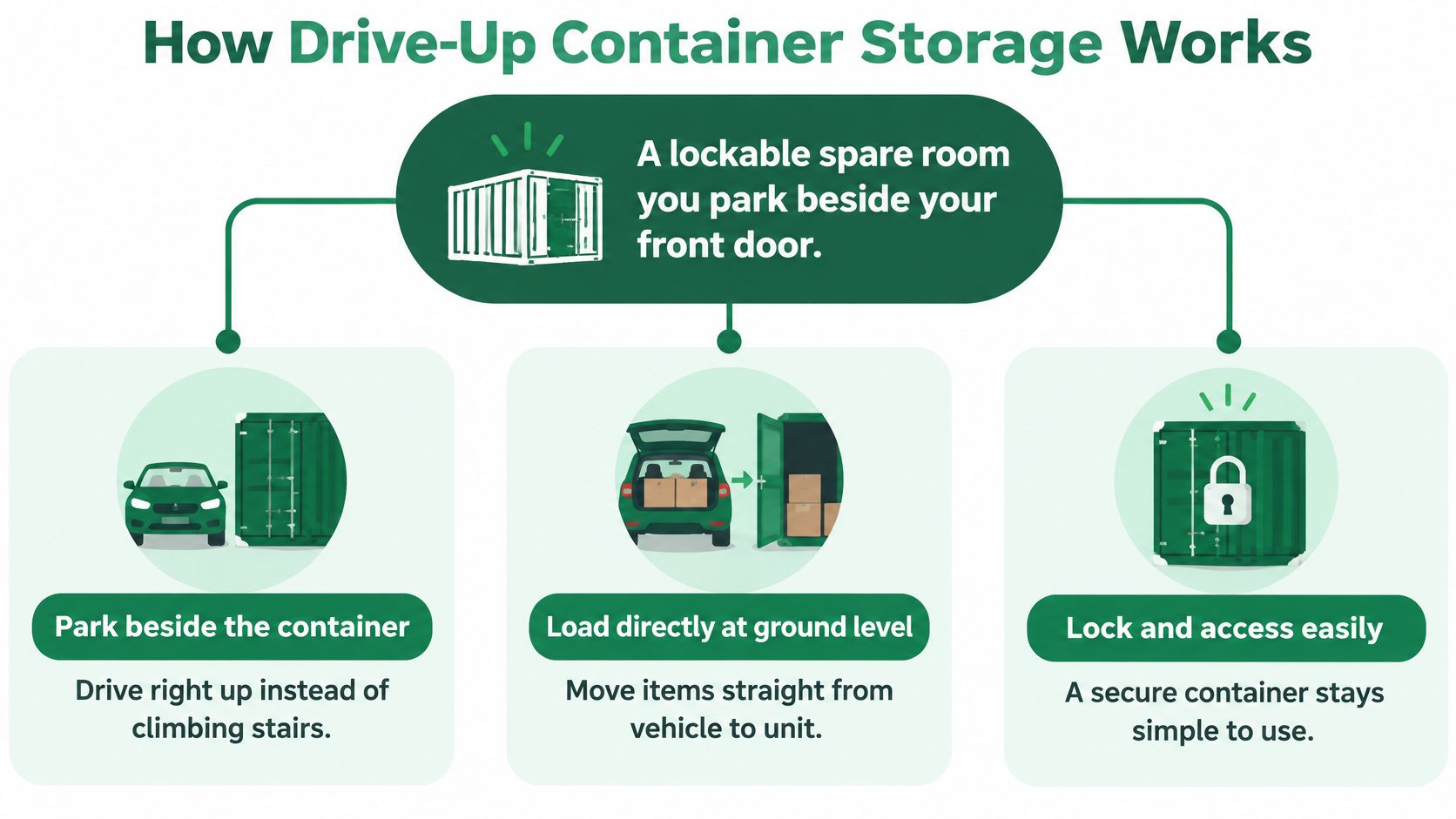
A drive-up container works like a lockable spare room parked at ground level. The vehicle comes to the unit instead of every box travelling through a building, and that single difference shapes loading time, handling risk and how often a visit is practical.
Three mechanics in order
First, ground level loading. A car or van parks alongside the door, so furniture, tools and boxes move directly from vehicle to container. Every lift or transfer point removed is one less chance to knock or drop something, which is why a full house move tends to run faster this way.
Second, separation. Contents sit in their own sealed unit away from the home or workplace, so rooms being renovated stay clear and working space isn't filled with surplus stock or equipment. At Saxondale, that sealed unit is dry and ventilated with a wooden floor and an anti-condensation lining as standard. There is a candid limit here. A lining manages condensation, but it cannot make a steel box behave like a heated room, so goods that need stable warmth still need a different answer.
Third, rolling terms remove the need to name a final date at the start. Saxondale prices monthly, with units starting from £110 a month including VAT and the first month at half price, so storage can continue while a completion date, tenancy change or building job slips by a few weeks.
That flexibility matters because moving dates slip so often. The English Housing Survey household moves fact sheet reported that approximately 5.2 million households, 22% of all households, had lived in their current home for less than three years in 2021-22. It also found 50% of private renters had been resident for under three years, compared with 14% of owner occupiers. Later editions of the same survey have continued to record a substantial share of households moving within any given 12 month period.
The deciding question is frequency of use. If the end date cannot yet be named, rolling terms on storage containers in Nottingham fit well. If items are needed every day, access becomes the main cost driver: a container only delivers value when its space and its convenience match how often it will be visited.
Matching Container Size to Household, Student and Business Needs
Judge a container by its floor space before its headline price. The 10ft unit gives about 80 sq ft for £110 a month including VAT, while the 20ft gives about 160 sq ft for £149 a month including VAT, so the larger unit costs less per square foot. Whether that extra space earns its keep depends on two things: how much of it you fill, and how often you open the door.
| Storage need | Suggested size | Shared use | Access pattern | Check before you book |
|---|---|---|---|---|
| Household between moves or during renovation | 10ft for a few rooms, 20ft for a full house | No | Occasional or none | Measure the largest furniture against 80 sq ft and 160 sq ft |
| Student storage between terms | 10ft | Yes, shared with housemates | Once or twice | Confirm the term end and move-out date |
| Surplus or seasonal retail stock | 20ft | Sometimes | Weekly or monthly | Non-perishable goods only, with room left to pick orders |
| Tools, materials and trade equipment | 10ft or 20ft | No | Weekly | No fluid-leaking equipment or motor vehicles |
| Paper records and document archives | 10ft | No | Rarely | Labelled archive boxes raised off the floor, with a logger inside |
Choosing a size works like hiring a van: the cheapest rate means little if the load needs two trips. Measure the largest items first. Sofas, wardrobes and white goods catch households out far more often than box counts do. Then add the boxed volume and compare the total against 80 sq ft or 160 sq ft. The space is three-dimensional, so with about 8 ft of internal height the stacking plan matters as much as the floor plan.
Access frequency is the second half of the decision. A container opened once or twice a year can be packed wall to wall, which makes cost per square foot the only number that matters. A unit visited weekly earns its money differently, because tools and stock reached for every few days justify room to work inside. Businesses weighing stock turnover against floor space can compare business storage options before settling on a size. Only two sizes are offered, so if neither looks right, ask the team rather than ruling container storage out.
Paper records need a stricter test
Paper follows different rules from sofas and stock. The UK National Archives environmental management guidance recommends approximately 13-20°C and 35-60% relative humidity for archival material, and warns that mould can germinate and spread once relative humidity exceeds 65%, while very dry conditions can make paper brittle.
Use closed, labelled archive boxes, raise them off the wooden floor, leave air gaps around shelving and place a digital temperature and humidity logger inside. Keep cartons away from external walls and the roof, where temperatures swing most.
A ventilated container with anti condensation lining isn't a climate controlled archive. Photographs, film, electronic media and irreplaceable records need a verified environmental regime.
Access Hours, Security and What You Can Store
Three worries usually decide whether a site works in practice. Can the reader get in when needed, are goods sensibly protected, and are the items allowed at all? Checking those points in that order avoids booking space that looks right but fails on moving day.
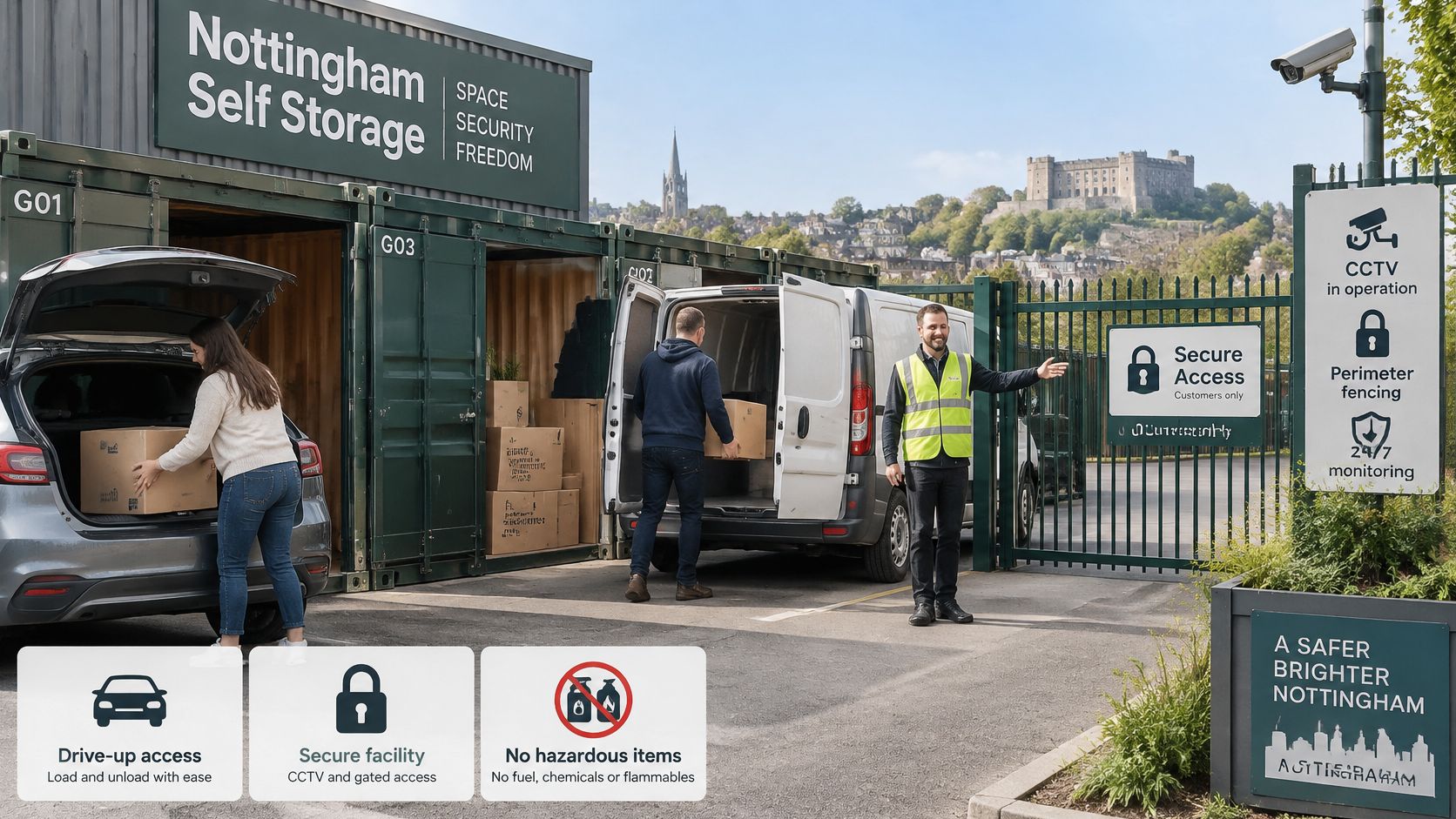
Ground level doors remove stairs and lifts, which matters for wardrobes and other bulky pieces covered by furniture storage. Both Saxondale Self Storage sites accommodate cars, vans and small trailers, but cannot accept HGVs. Access runs from 7am to 7pm every day, and gates are locked outside those hours, so van hire and helpers should be planned inside that window.
Layered security
Look for more than a padlock. A sensible set of controls includes CCTV, floodlighting, locked gates, staff on site on weekdays and an individual lock on each unit. No single measure does the whole job, which is why layers matter.
Lawful use controls sit alongside physical security. Highland Council Trading Standards guidance on counterfeit goods describes a self storage code of practice designed to prevent storage of counterfeit and other illegal goods and to help operators establish who is storing what. Highland Council is in Scotland, so that's an example of UK sector practice rather than Nottingham regulation, and exact checks depend on the facility's current terms.
What must stay out
- Illegal, dangerous or flammable items: Nothing unlawful or hazardous belongs in a unit.
- Perishable or living things: Food that can rot, plants and animals aren't permitted.
- Vehicles and leaking equipment: Motor vehicles, quad bikes, motorbikes and anything that could leak fluid aren't permitted.
- Anything harmful to others: Items that could damage the property or other customers' goods must stay out.
A quick self test works well. If an item leaks, rots, runs on fuel or could harm neighbouring goods, it shouldn't go in.
Real Storage Situations and How Each Plays Out
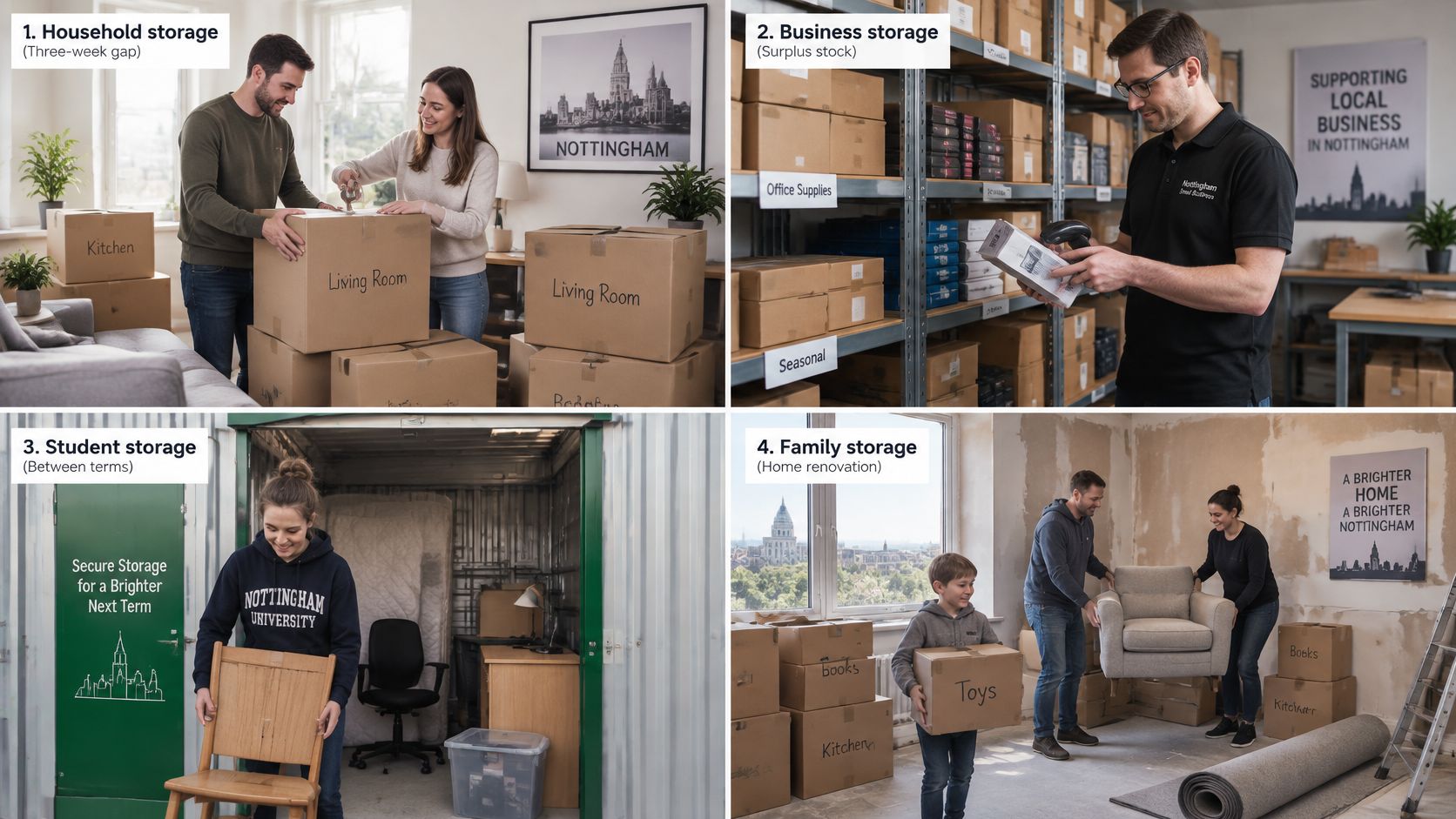
Each case below turns on the same two questions: how much floor space the load needs, and how often the doors open. Monthly rent comes third.
A household with a three week gap. A family sells one home before the next purchase completes, and the whole contents go into a 20ft container: dry, ventilated, wooden floored, with room for full furniture sets. Rolling terms mean nobody guesses at an end date. Booking a 10ft because £110 beats £149 looks thrifty until the sofa has nowhere to stand.
Two students leaving for summer. Housemates can share a 10ft unit through student storage, split the monthly cost and make one van trip, while a first month at half price trims a short stay further. The Nottingham City Council student accommodation update recorded 36,334 purpose-built student bedspaces in 2025, up from 27,510 in 2021, alongside a 10.6% fall in on-street student households between 2021 and 2025. One reading of those figures is that belongings still need a home at every tenancy changeover, so booking early against confirmed dates beats bargain hunting in the busiest weeks.
A retailer with seasonal stock. Boxed, non perishable goods collected weekly suit a 20ft unit, and here layout is a cost line of its own. An aisle looks like wasted space on paper, but stacking to the door turns every collection into a full unload. The aisle pays for itself in hours saved.
A tradesperson storing tools. Daily visits flip the sum again. Total capacity matters less than reaching kit fast, so the smaller unit works like a workshop annexe: a fixed spot the van backs up to each morning rather than a room emptied once a year.
Across all four, the headline rent misleads. At £110 a month for 80 sq ft and £149 for 160 sq ft, the larger container doubles the floor area for far less than double the price, so the honest comparison is cost per square foot set against how often anyone needs to open the doors.
Answers to Common Container Storage Questions
Is a container a substitute for a warehouse
That depends on what happens inside the space each day. A container suits durable, bulky goods accessed occasionally, such as tools, fixtures, boxed records and seasonal stock. Daily picking, customer collections or staff working inside for hours call for conventional commercial premises, and HGV loading settles the question on its own, since container sites of this kind accept cars, vans and small trailers rather than HGVs.
The boundary is frequency of use. The 160 sq ft unit already costs less per square foot than the 80 sq ft one, and holding space is where that value shows up. A business that needs working room should measure premises on a different basis.
Can a business store temperature sensitive stock
Only with evidence that the environment stays inside the range those goods require. A standard container is ventilated and lined against condensation, and temperature and humidity still move with the weather outside. Perishables are ruled out by the storage terms regardless, so food never reaches this question. Sensitive electronics, artwork and irreplaceable media sit in the same position: each needs a verified environmental regime before storage is worth considering.
Ask which conditions are monitored and recorded. A data logger produces evidence. A feature list produces a description.
How long should items stay in storage
Rolling terms carry no fixed end date, subject to a one month minimum, so items can stay while a move, renovation or stock cycle finishes. A rough timeframe still helps budgeting, because the monthly charge keeps arriving whether or not anyone visits.
The habit worth building is a periodic review: remove anything no longer needed and re-check the size. Once visits turn weekly, the unit is being used as workspace rather than storage, and that changes which option offers value.
Who is responsible for insurance on stored goods
The agreement decides, so check whether contents insurance comes included, can be added to the booking or must be arranged separately. Saxondale Self Storage offers the latter two routes: cover can be added to a booking, or customers arrange their own. Stock, tools and equipment should be valued carefully before they go in, because undervaluing contents leaves a shortfall after a claim.
Site security and insurance do different jobs. Security lowers the chance of a loss. Insurance covers the cost if a loss happens anyway.
Who may need archive storage
Any business whose paperwork must be kept longer than its filing cabinets allow. Micro businesses, tradespeople, retailers and office based firms often hold invoices, contracts, personnel files or stock records that have to be retained yet have no place in daily working space.
Paper archives store well in a container when they are packed properly. Ventilation and anti-condensation lining keep conditions dry, and the wooden flooring suits boxed files. Label every box, keep a written index, group files by retention date and leave the boxes needed soonest closest to the door.
Confirm Size, Access and Terms Before You Book
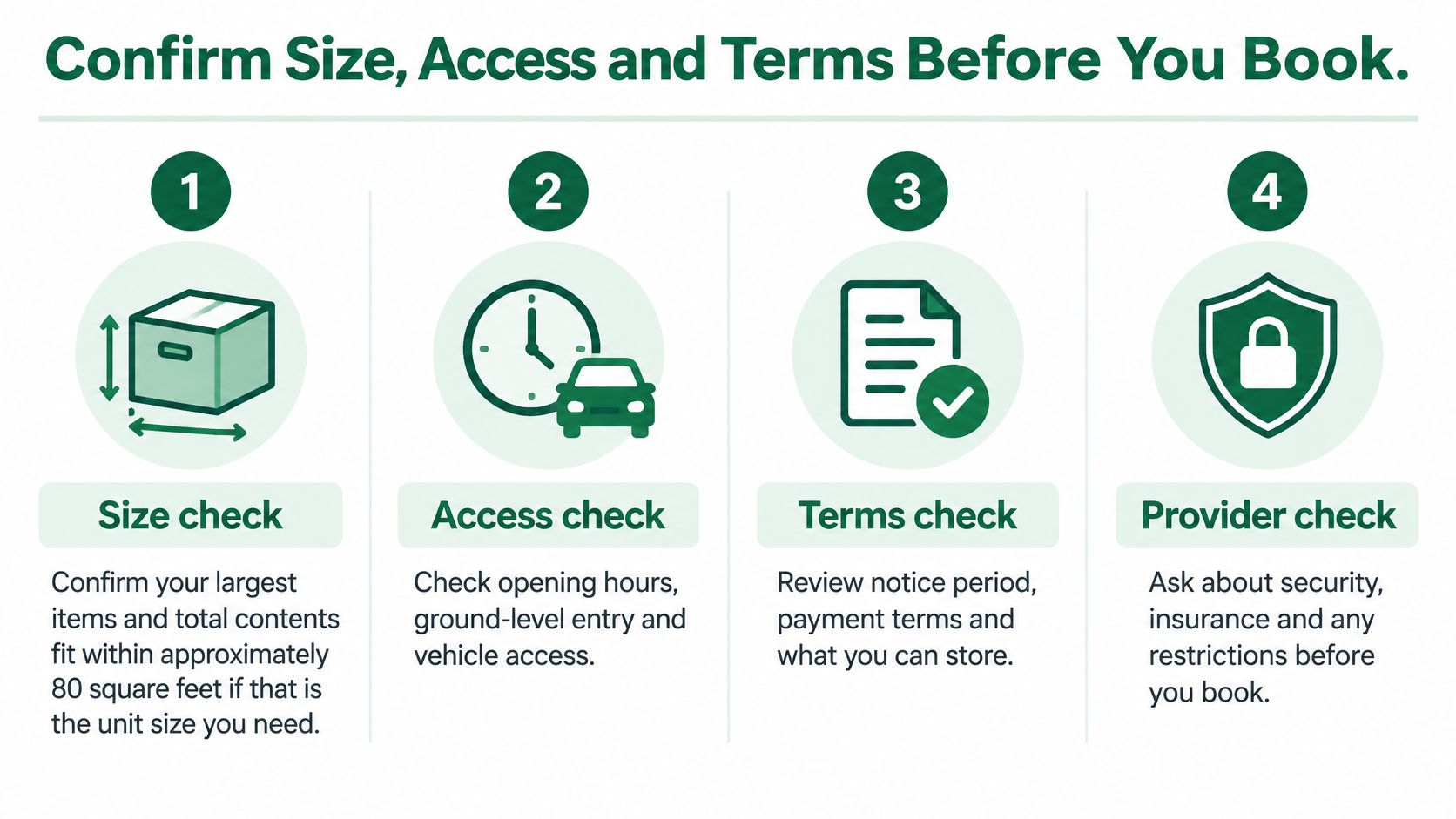
Before paying, focus on the details that change the total cost or cause a problem on move-in day.
- Confirm the notice period: Ask how a rolling month ends and what date to give notice.
- Check the price after month one: The first month is half price; confirm whether the unit then reverts to £110 for 10ft or £149 for 20ft including VAT.
- Ask about an in-between load: Only 80 sq ft and 160 sq ft are listed, so if contents sit awkwardly between them, contact the team before booking.
Value is easier to judge by use than by headline rent. The 20ft unit spreads a higher monthly price across about twice the floor space, which can suit a three-bedroom load or items needing room to manoeuvre. The 10ft keeps the monthly outlay lower when access is occasional and the load is compact. The better choice is the one that matches measured contents and leaves enough room for the access pattern you expect.
Saxondale Self Storage runs sites at St James Business Park in Radcliffe on Trent and Upper Saxondale Business Park, east of Nottingham. Contact 0300 124 7544 or info@saxondaleselfstorage.co.uk to confirm terms and arrange a viewing.
For drive-up storage containers in Nottingham with ground level loading, rolling monthly terms and two clear sizes to compare by cost per square foot, readers can check availability and current terms with Saxondale Self Storage. A viewing or a short conversation about measured contents will quickly show whether a 10ft or 20ft unit is the sensible fit.